


I was scrolling through LinkedIn a few months ago when a short post caught my eye.
It featured a quote from Joe Harless:
“Inside every fat course, there’s a slim job aid waiting to get out.”
I’ve seen enough overweight courses over the years to know exactly what he meant.
And if I’m honest, I’ve probably helped create a few.
Anyway, the quote made me laugh out loud and prompted me to click through to the profile of the person who had shared it — Guy Wallace – a (now retired) L&D and performance improvement specialist.
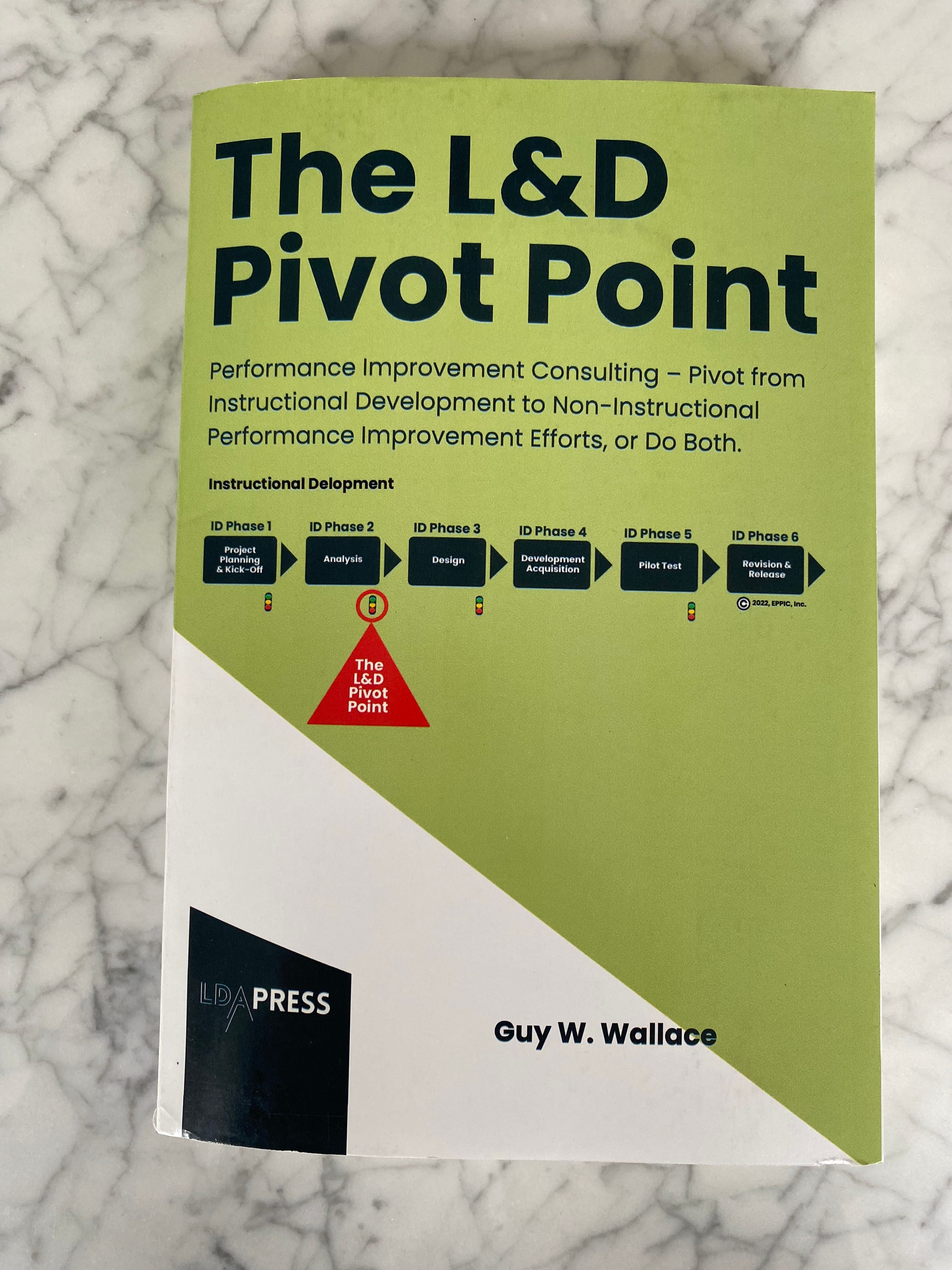
I’ve just finished reading one of the many books he has written. It’s called The L&D Pivot Point.
An adjacent but familiar world
The work Guy Wallace did during his long career sits inside a field often referred to as Human Performance Improvement (HPI).
The central idea (not unfamiliar to those of us in L&D) is that training is only one of many possible solutions to a performance problem. Not just What do people need to learn? but What’s stopping performance — and what would actually improve it?
Of course, the answer might be training. But it might just as easily be:
a process change
a better tool
clearer expectations
different incentives
improved management support
In other words, learning is just one lever in a much larger system.
Why it can feel so different
As I started reading more of the book, for me, one thing stood out very quickly. Everything seemed to come back to process. Process maps. Task breakdowns. Workflow analysis.
But what became clearer wasn’t just the focus on process itself — it was what that focus was trying to achieve. At its core, it seems to me that this way of thinking is about making performance more reliable.
If the process is well defined, the environment is set up correctly, the right tools, inputs and expectations are in place, then (HPI thinking goes), the performance should become more consistent. More predictable. Less dependent on individual variation.
And in many contexts, that makes complete sense. If you’re dealing with repeatable work, where variation creates risk or inefficiency, then stabilising the process is exactly what you want to do. It’s not just about improving performance. It’s about making performance dependable.
What HPI sees clearly (and we in L&D sometimes don’t)
To achieve this, the HPI world is very good at asking:
Are people actually able to perform this task?
Is the environment set up correctly?
Are the tools fit for purpose?
Are expectations clear?
Are there competing pressures that make the “right” behaviour unlikely?
Overall, HPI-style diagnosis is very good at remembering that every performance problem is situation-specific. A useful corrective to a very familiar pattern in L&D where a request comes in and the training solution quietly starts to take shape before the problem has really been explored.
But that’s not the whole picture…
But it seems to me there’s a bit more to the ‘is it training or is it something else’ puzzle. Because even when performance is stabilised as far as it reasonably can be, what actually happens when someone is doing the work?
Even when the process is clear, the right tools are available and people are incentivised to do the right thing for the right reasons, performance can still vary — sometimes dramatically.
A quick example
Take something like a sales negotiation. You can define the process quite clearly:
prepare for the conversation
establish needs
present options
handle objections
close or agree next steps
You can train it. You can practise it. You can even build very detailed guidance around what “good” looks like at each stage. And yet, when two different sales people start to work through that process, the experience and outcomes can play out very differently.
One person reads the room well, adjusts their approach and handles an unexpected objection smoothly. The other follows the same overall flow, but hesitates when the conversation shifts; or sticks too rigidly to what they were taught; or loses confidence when something doesn’t quite go to plan.
Exact same process. Different performance. And that difference isn’t fully explained by the stability of the process itself. And it isn’t fully explained by the quality or quantity of training provided either.
Because neither training nor process stabilisation can fully:
anticipate every variation
simulate every real-world condition
prepare people for every judgement call they’ll face
At some point, people have to step into the work itself. And that’s where things get more complicated and potentially messy
The space in-between
Clearly, L&D and HPI are each solving part of the same problem. But it seems to me that neither quite addresses something else. Which is this. What helps people perform well, in real conditions, while they’re actually doing the work?
In other words, not deciding whether to train. Not designing the training. But supporting performance as it unfolds.
That feels like a slightly different category. Not instruction. Not process design. But something in between.
A different kind of challenge
One way to think about the difference is this. Many performance improvement approaches are trying to reduce variability by:
standardising the process
eliminating unnecessary variation
making outcomes predictable
That works extremely well when tasks are repeatable, variation is undesirable and “good” can be clearly defined
But a lot of modern work doesn’t behave like that. It tends to be:
Interpersonal
judgement-heavy
context-dependent
full of small variations that matter
In those situations, you can’t completely eliminate variation. You can only work within it.
Which shifts the question from How do we control performance? to How do we support good judgement within performance?
More relevant than ever?
This isn’t entirely new thinking. Elements of it have been around for a long time, often under labels like performance support or workflow learning. But to me, this feels increasingly relevant. Because these days, more roles involve:
interpreting ambiguous situations
making decisions with incomplete information
adapting to conditions that don’t quite match the “training example”
In those contexts, preparation still matters. Process design still matters. But neither fully closes the gap.
A small shift in perspective
One of the most interesting implications of exploring this “in-between world” is that it slightly reframes a very familiar question. Instead of asking: Is this a training problem?we might start asking: What actually helps someone succeed when they’re doing the work?
Sometimes the answer will still be training. Sometimes it will be a better process. But sometimes it may be something else entirely. Something that sits closer to the moment of performance itself.
Coming back to where this started
That original quote from Harless still holds up. There probably are plenty of courses that could be turned into something simpler, more focused, and more useful.
But the more I think about this, the more I’ve started to wonder whether that’s only part of the story. Because even when the course is good, even when the process is clear, performance doesn’t end when the learning does.
And for us in L&D, that might be where the more interesting work begins.
Until next time…
Andrew