


Like most people who have done training delivery over a good number of years, I’ve had my high moments and my lows. And for better or worse, it’s that very small number of low moments that you often remember most vividly.
One of my top three clangers was meant to be a day focusing on instructional design for e-learning. By the morning break I knew I was losing the group. Everything I had covered up to that point had been shot down and thoroughly trashed by two very negative attendees.
After the morning break, the pile-on intensified as other attendees decided to join in. By the afternoon all was lost. It was truly a case of just getting through to the end of the day without a complete meltdown.
Yet, ultimately, it was a cloud with a silver lining. Because out of that dreadful day came the realisation that what I had been teaching up to that point was really just re-hashed conventional wisdom.
Not wanting a repeat of that experience was enough to motivate me to dig deeper, which led me to the work of Michael W. Allen, whose ideas about e-learning and its design absolutely transformed my view of the medium.
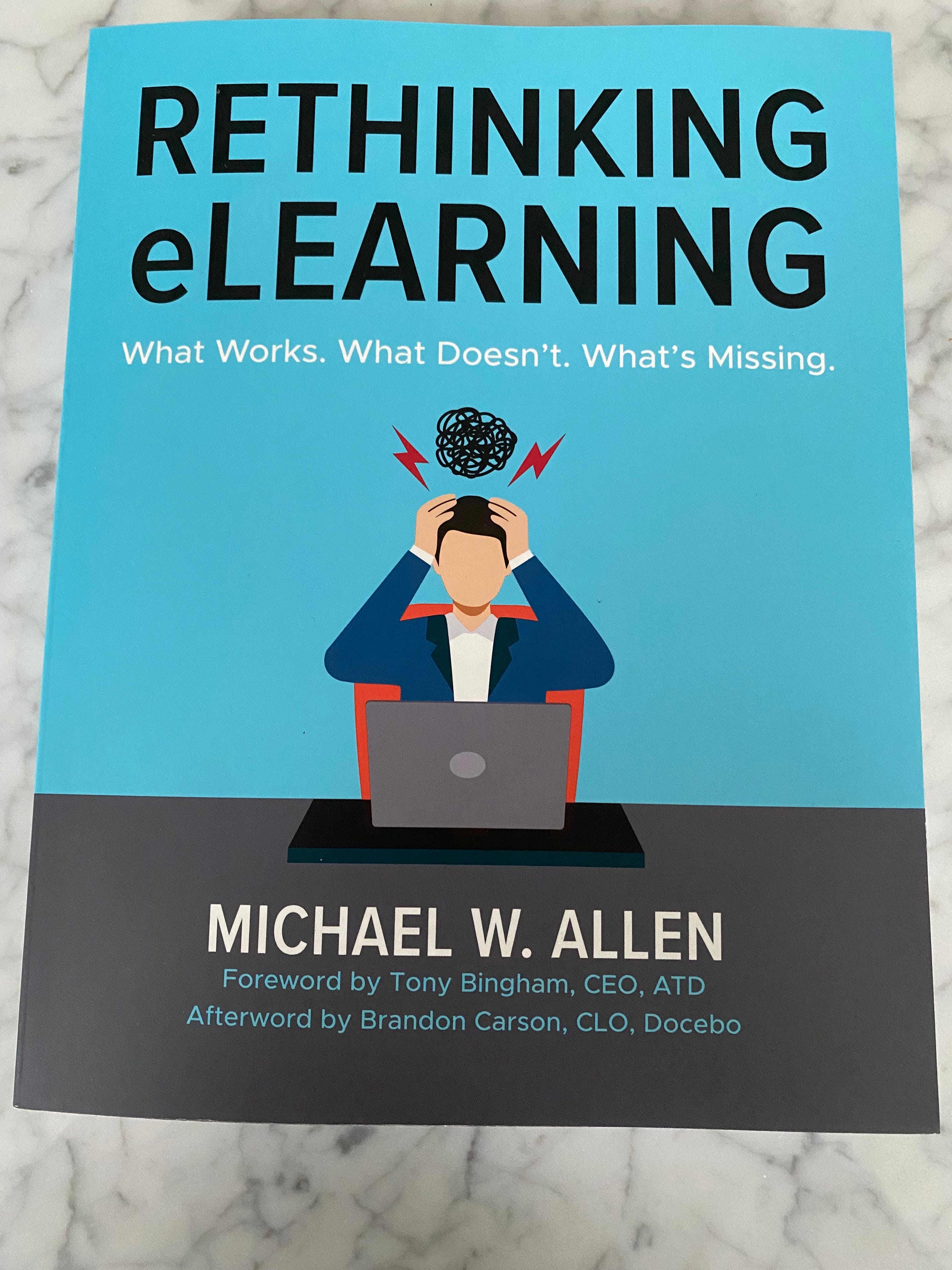
While he’s always been a prolific author, speaker and practitioner, he hasn’t written any books for quite a few years now. So, I was quite excited when I learnt that he had just published a new book - Re-Thinking E-Learning.
I’m part way through it and so this week I wanted to share some of what I’ve read so far and some thoughts on what I’ve read.
A quick Michael Allen primer
If you’ve worked seriously in e-learning over the last twenty years, there’s a good chance Michael Allen’s thinking has influenced your instructional design work somehow – even if you never realised it.
Allen was one of the earliest and strongest critics of what e-learning often became during its rapid corporate expansion years: digital page-turning. Content-heavy modules. Endless clicking through screens. Knowledge checks that tested recall rather than judgement or application. PowerPoint on steroids as I frequently call it.
Instead, he argued for something much more experience-based. Learning that placed people in situations. Learning built around challenge, decision-making, consequences and feedback. Learning where the learner had to think, not just consume.
Not a complete re-think
What’s interesting about Re-Thinking E-Learning is that its title is a call to change conventional instructional design thinking, not an indication that Allen is reversing previous ideas. Indeed, if you are already familiar with Allen’s work, you’ll quickly realise this is a refinement of what’s gone before. A sharpening of emphasis. A recognition that what he now sees as some of the most important aspects of e-learning may have sat slightly in the background in his earlier thinking.
In my view, one of his most interesting shifts in emphasis is this:
“There’s no learning the learner. You can’t do the learning for them.”
That sounds almost absurdly obvious when stated plainly. But I think it points toward something important that can easily get lost in L&D conversations.
We often talk as though learning outcomes are primarily produced by instructional design itself. Better structure. Better sequencing. Better interactivity. And all of those things absolutely matter. But Allen is urging us to pay much more attention to something else entirely: the emotional and motivational state of the learner.
Not just what learners know. But how they feel. How motivated they are. How invested they are in overcoming challenge. Whether they actually want to persist when things require more effort.
Motivation changes the equation
One of the reasons this resonated so strongly with me is because it connects directly to something I wrote about a few weeks ago after sitting through a three-hour training session that broke every rule of good instructional design.
The slides were dreadful. The structure was weak. The interaction was minimal. And yet…I came away from the session genuinely satisfied. Why? Mainly because I was highly motivated to learn more about the skill the training covered.
Where things start to get really interesting is that Allen recognises it’s not just learner motivation that can be a game changer but what he refers to as affective influences – literally the things having a direct impact on the emotional state of the learner.
The emotional side of learning
Often e-learning conversations tend to focus heavily on cognition and information processing, revolving around questions about how we:
reduce overload
sequence content
improve retention
avoid unnecessary cognitive burden
All extremely valuable questions.
But Allen’s newer emphasis seems to push us further toward affective influence — the emotional side of learning.
There are two parts to this. First, what are the affective influences that are likely to be stirring as the learner embarks on their learning journey? Second, as designers, once we understand those influences clearly, what can we do to maximise those influences that will help? And minimise those influences that will hinder? That’s a noticeably different emphasis.
And importantly, it doesn’t diminish instructional design. If anything, it expands it. Because if learning is partly emotional and motivational, then good design isn’t just about making information easier to process. It’s also about influencing whether learners want to keep processing it in the first place.
What games understand exceptionally well
This is where Allen’s discussion of games and gamification comes in.
And thankfully, this is not the tired “points, badges and leaderboards” version of gamification that many of us became weary of years ago.
In fact, Allen references Yu-kai Chou and his book Actionable Gamification, which explicitly argues for moving beyond superficial reward systems, toward a much deeper understanding of human motivation.
In short, Allen sees gamification as all about motivation, not mechanics.
Many conventional e-learning experiences create emotional conditions which cause learners to become cautious, defensive or passive. Particularly in corporate environments where being wrong can feel uncomfortable or risky. A motivation killer, if ever there was one.
By contrast, that gamification (when done well) can create the opposite dynamic. It can invite experimentation, reward persistence and encourage recovery and adaptation.
Challenge before content
Another strong thread running through the book is the idea that learning should begin with challenge and experience, not lengthy upfront explanation.
We are all too familiar with the traditional sequence that e-learning frequently follows:
Tell the learner everything
Show a few examples
Add a small knowledge check at the end
The assumption is that once learners have absorbed enough information, they’ll eventually be ready to apply it.
But starting with the challenge, creating tension and giving learners something meaningful to wrestle with, allows explanation and guidance to arrive naturally, in service of solving the problem.
That’s a fundamentally different emotional experience for the learner. Because once learners are trying to solve something, explanation has a much clearer purpose. Specific pieces of information suddenly become highly relevant and meaningful rather than merely available.
This inversion of traditional thinking, is definitely not new in Allen’s work. But combined with his refined thinking around motivation and affective influences, challenge-first, experience-led e-learning feels more powerful than ever.
Perhaps the bigger shift…
If you to talk to most people in L&D about ‘fixing’ e-learning the words ‘engagement’ and ‘interactivity’ will almost certainly come up. So, my other big takeaway from what I’ve read so far is that Allen believes the real fix for e-learning could be something else entirely.
It may be about recognising that a learners’:
motivation
confidence
persistence
emotional state, and
willingness to engage with challenge
all fundamentally shape learning outcomes far more than we might like to acknowledge. Which means that excellent instructional design alone can only ever take us so far.
That doesn’t make instructional design less important. If anything, it makes it more interesting. Because if we really want better outcomes, perhaps we need to spend just as much time thinking about what makes learners want to engage and persist as we spend thinking about how to design the learning experience itself.
Until next time,
Andrew
PS: Many of these ideas around motivation and affective influences, challenge-based learning and supporting real-world application will be an integral part of this September’s Learning Re-Framed public programme. I’ll share more details on this shortly.